

East Lansing — When the 2026 FIFA World Cup kicks off Thursday, billions of soccer fans around the world will have their eyes glued to the action on the field.
John “Trey” Rogers III may find himself more focused on the field itself than the gameplay.

“I’ll be watching the grass, that’s for sure,” said Rogers, the 66-year-old sod guru at Michigan State University’s College of Agriculture and Natural Resources.
Rogers led the team of MSU researchers who helped get the fields at each of the 16 stadiums holding World Cup matches ready for what figures to be the most-watched single-sport event in history.
When the international soccer federation known as FIFA selected the host cities in 2022, it faced a daunting challenge: creating a consistent playing surface across venues ranging from open-air stadiums in Mexico City and Miami to roofed facilities in Vancouver, British Columbia, Atlanta and Houston.
Using the facilities’ normal field of play wasn’t an option. Half the stadiums normally use artificial turf, which FIFA doesn’t allow for major tournaments. Even the stadiums with grass fields would have to be reconfigured to ensure consistency across the sites.
“This tournament is a big one,” Rogers said. “Forty-eight teams, 16 stadiums, three countries, several time zones, several climatic zones.”
To tackle that problem, FIFA launched a five-year research project with experts at MSU and the University of Tennessee, both of which are internationally recognized for their research in sports turfgrass.
Rogers said FIFA’s financial investment was somewhere between $6 million and $7 million. He said that kind of money is sometimes put into golf turf research, but rarely for other sports.
“When you get that kind of investment, it’s pretty cool,” Rogers said. “But you also have a responsibility to make sure it satisfies not only FIFA’s needs, but everyone’s needs.”
World Cup will showcase MSU’s 70-year-old program
The World Cup will be a showcase for Rogers and MSU. The university’s Turfgrass Management Program is more than 70 years old, and more than 2,000 program alumni are employed at stadiums, fields and golf courses around the world.
Rogers has been with the department for going on four decades. While the 2026 World Cup project is the biggest he’s faced in terms of size and scope, he was able to draw from his experience on a major project three decades ago, when the World Cup came to Michigan.
In 1994, he helped pioneer techniques that temporarily replaced the Pontiac Silverdome’s artificial turf playing surface with natural grass.
Among the former MSU undergraduates who worked with Rogers on the Silverdome project was John Sorochan. Now, 32 years later, Sorochan is a distinguished professor of turfgrass science and management at the University of Tennessee, as well as a special adviser for FIFA, who worked with his MSU mentor on the new playing surfaces.
When FIFA first spoke to Sorochan in 2018 about helping develop pitch plans for the 2026 World Cup, his first thought was to reach out to Rogers and “get the band back together,” Sorochan said.
Rogers said he and Sorochan had almost daily conversations over the past several years as they planned and tested different playing surfaces, growing techniques and drainage systems.
“We rely on each other,” he said.
Together, they accepted a multimillion-dollar FIFA grant and embarked on the five-year journey that will finally come to fruition when the World Cup group stage is scheduled to get underway on Thursday.
“I’m excited. It’s been a long time coming,” Sorochan said. “We did, I think, 160 or 170 different trials between the two universities.”
Research teams decide on two turf types and how to shift the grass roots
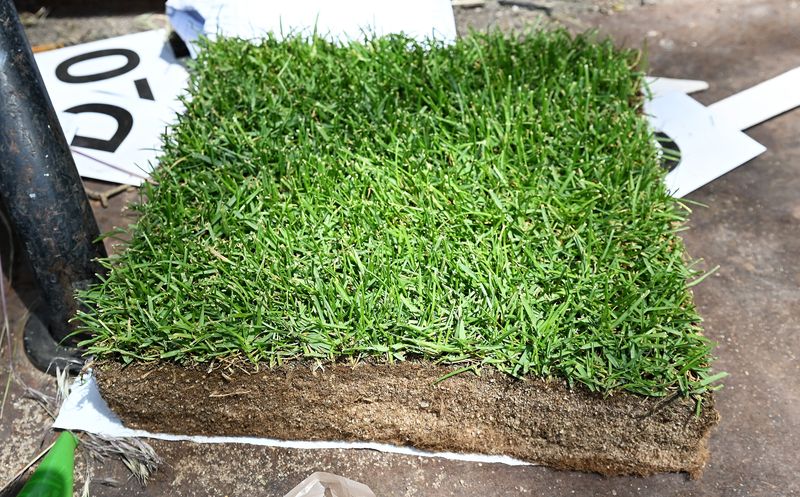
The team ultimately decided to use two types of grass — Bermudagrass and a Kentucky bluegrass/perennial ryegrass blend. Each stadium got one type or the other, depending on the climate and stadium-specific factors like roofing type.
Deciding which stadiums would get which type of sod was literally just the surface-level issue. The researchers’ plans went much deeper.
About 18 inches deeper, to be exact.
Below each World Cup playing surface is a system specifically designed to keep the sod from becoming too dry, too wet, too slippery, too lumpy or too anything else — other than an ideal soccer pitch.
“The magnitude of the tournament requires (converting) these stadiums, which aren’t largely meant to host a soccer game. A lot of them are typically NFL stadiums,” said Zachery Flink, a recent graduate of MSU’s turfgrass management program who worked on the World Cup project throughout his undergraduate studies.
Beneath the top layer of sod is a plastic fiber “carpet” used for reinforcement to keep the turf from slipping, even during intense play. Next comes a 6- to 12-inch sandy “rootzone” containing the grass root system, Flink said.
This system, often simply called “sod on plastic,” allows the roots of the grass to spread horizontally, rather than vertically as they grow naturally. This makes harvesting and transportation more manageable.
“The roots don’t have to be cut or sheared upon harvest, so much like when you have a plant in a pot, you will have the full system intact, and it’s ready, it’s fully operable,” Flink said. “The minute it’s harvested, you can plant it right then and there.”
Below the sod and plastic carpet is 4-6 inches of gravel (or, for some stadiums, a plastic drainage module), which drains excess rainwater. Deeper yet is a vacuum and ventilation system that ensures proper air circulation.
Rogers credited his research teams for hitting tight deadlines, so there was plenty of time for farms around the country to grow the sod.
“This is not one of those things where you say, ‘I’ll come back six months later and work on it,'” he said. “We’re not delaying the World Cup.”
The sod was grown on private sod farms in New Jersey, Colorado, North Carolina and Washington, according to the specifications carefully calibrated by the research team. Rogers said some of the farms had no prior experience growing sod on plastic, so the research team had to instruct them.
“What they didn’t know, we taught them,” he said.
Rogers called the farms the “unsung heroes” in the project.
“They were also given a very stringent timeline, as well as a set of specs, and they have delivered,” he said. “You’ve got to remember, they have delivered (sod) 1,400 miles, 2,000 miles (away).”
Among the World Cup facilities are stadiums in three Mexican cities, including Mexico City; two cities in Canada, including one in Toronto; and 11 U.S. cities, including SoFi Stadium in Los Angeles and Lumen Field in Seattle.
With each pitch totaling 7,140 square meters, the growers were responsible for producing 28.2 acres of sod for World Cup play, plus dozens of additional acres needed for quality control, testing and contingency needs.
Ready for play
Once ready, the sod was harvested, rolled and transported to each stadium, where it was installed last month.
For example, the sod at MetLife Stadium in East Rutherford, New Jersey, (which, for the World Cup, will be known as New York New Jersey Stadium due to FIFA’s rules regarding corporate sponsorship) was laid over the stadium’s artificial turf over two days in early May, FIFA said.
The Bermuda grass pitch was hauled by truck to the New York City area from the Carolina Green Turf Farm in North Carolina.
When the sod is laid, it takes another four or five days for groundskeepers to complete the “hybrid stitching process,” which securely fastens each individual roll of turf, FIFA said.
“Once that is done, we will continue with some top dressing and some aeration, general practices that we would have – mowing, watering, irrigation,” said David Graham, a senior pitch manager for FIFA, in a statement. “And then we just rinse and repeat until we start getting closer to the tournament.”
Some partially enclosed stadiums, like in Dallas, used grow lights to preserve turf density, color and root strength while the field acclimated to stadium conditions, officials said.
With the first round of play a couple of days away, Rogers and Sorochan are confident they’ve delivered a world-class product for the World Cup. Rogers said he’ll be watching one match in person in Kansas City, where his daughter resides.
For Sorochan, the Tennessee professor who credits his time at MSU for developing his interest in turfgrass science, the event is a full-circle moment.
“I was a student 32 years ago when the World Cup came to Michigan, and it’s been a joy now seeing my undergraduates, graduate students, technicians and even high school kids as they’ve got to work on this project and how they’ve been inspired,” he said.
Flink, the recent MSU graduate who will be pursuing his master’s degree in East Lansing under Rogers, is looking forward to seeing his work in action.
“It’s been a while since I’ve been able to just watch any (sports) game without looking at the grass,” Flink said with a smile. “But I think it’s going to be exciting to see something that I’ve been a part of with millions of people watching.”
mreinhart@detroitnews.com
This article originally appeared on The Detroit News: How MSU got 16 stadiums across North America ready for the World Cup
Reporting by Max Reinhart, The Detroit News / The Detroit News
USA TODAY Network via Reuters Connect
By Max Reinhart, The Detroit News | USA TODAY Network
