

U.S. lawmakers are seeking stronger measures to protect the domestic automotive market from subsidized, low-cost Chinese competitors, just like other countries have for years established policies to safeguard their homegrown manufacturers from foreign rivals.
Two narratives have emerged globally as Chinese brands like BYD Co. Ltd., Chery Automobile Co. Ltd. and others increase exports to other nations and begin manufacturing outside of their native homeland: In Europe, legacy automakers have struggled to fend off the newcomers and now contemplate closing plants for the first time. Meanwhile, major auto-producing countries in Asia have restricted the entrance of foreign competitors. The challenge, however, is balancing protection and competitiveness.

For now, Chinese vehicle brands selling in the United States are nonexistent, with Zhejiang Geely Holding Group-owned Volvo and its Polestar electric vehicle unit being the single major exception. Arguing economic and national security protections, EV tariffs of 127.5% instituted under Presidents Joe Biden and Donald Trump, as well as regulations that will prohibit the use of Chinese software and hardware in vehicles, have managed to hold off these rivals — for now.
“When it comes to the U.S. industry itself, we are extremely protective, as we should be, like China, South Korea and Japan are,” said Jim Farley, CEO of Ford Motor Co., on the company’s latest earnings call. “What that means in specific policies, that will play out in our strategy as a company.”
U.S. concerns mount
Bipartisan legislation introduced by lawmakers, including a few from Michigan, has sought to reduce Chinese vehicle access to the United States, even for day trips from Canada and Mexico. The proposed legislation would install outright bans on Chinese vehicles and technology, including loopholes for joint ventures, set hard deadlines for bans, raise civil penalties for noncompliance and add a congressional check on any waivers.
In addition to concerns that internet-connected vehicles could become a national security danger, automotive executives have said Chinese government subsidies of its auto sector and supply chain, intellectual property theft, and differences in labor standards and practices create an uneven playing field to compete directly with Chinese brands.
General Motors Co. and Ford Motor Co. declined requests for interviews on policy objectives to ensure a protected U.S. market and a level playing field. Jeep and Chrysler parent Stellantis NV directed comment to the Alliance for Automotive Innovation, which joined with four other automotive-related trade groups to urge protection of the U.S. market from Chinese rivals to Trump administration officials ahead of the president’s Beijing summit last month.
“The competitiveness of the domestic auto industry and its workers will be damaged,” John Bozzella, CEO of the Alliance, said in a letter in December to the House Select Committee on the Chinese Communist Party, “if Chinese automakers and battery manufacturers are allowed to do in the U.S. what they have already been permitted to do around the world.”
Foreign response
Chinese automakers are dominating their home market, having surpassed the share of foreign joint ventures that previously counted on the world’s largest automotive market for growth. Now, with more capacity than there is demand for vehicles in China, companies based there have looked to other countries to export and is eating up share in places like Mexico, South America, Australia, Europe and other Asian nations.
The impact has rattled Europe. Chinese brands represent about 20% of the EV market there, and growth has come quickly with their ability to double overall market share year-over-year. Although the European Union slapped up to 35.3% tariffs on Chinese electric vehicles, subsidies have helped Chinese companies continue exporting to Europe and still make a profit. Automakers also quickly pivoted to hybrid products to bypass the import taxes.
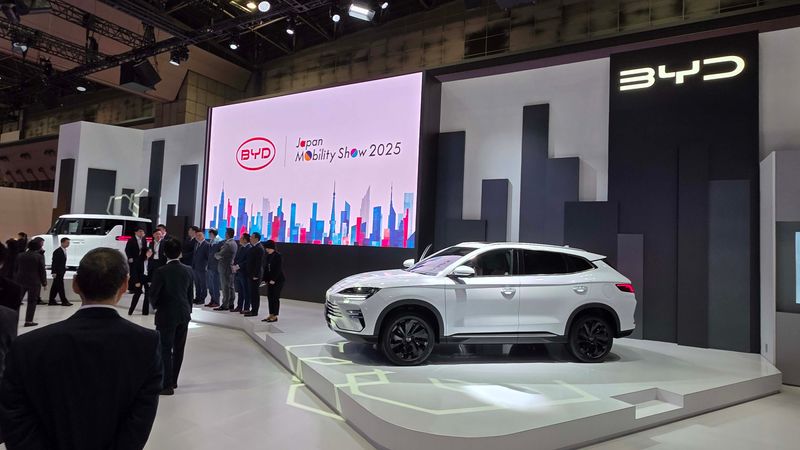
Meanwhile, the world’s largest EV maker, BYD, has built a plant in Hungary, and other Chinese brands have taken over old auto plants on the continent. Now, companies like Volkswagen AG are laying off workers and evaluating unprecedented decisions to close plants.
“It took the Koreans and the Japanese automakers more than 10 years to grab a double-digit share of the market, for example, in Europe,” said Fabian Piontek, a Munich-based partner and managing director at consulting firm AlixPartners LLP. “We’re currently under the assumption that the Chinese automakers will land there rather sooner than those 10 years.”
Contrast that to Japan, where Chinese automakers hold less than 1% of the market, and domestics represent more than 90%. Historic tensions with China, loyalty to domestic Japanese brands and a preference for hybrids over all-electric models has contributed to limitations for Chinese competitors in the homeland of Toyota Motor Corp. and Honda Motor Co. Ltd. BYD has doubled its sales in Japan, but sales remain limited.
Historically, Japan limited foreign ownership, controlled imports and used industrial policy through its Ministry of International Trade and Industry to direct capital and technology into domestic automakers after World War II, said Bill Russo, CEO of consulting and investment platform Automobility Ltd. in Shanghai.
South Korea followed a similar model in the 1970s to 1990s, with the government channeling financing and support for companies like Hyundai Motor Co. and Kia Corp., while restricting foreign competition. Luxury taxes on imports and leniency on regulatory compliance for domestic players compared to foreign manufacturers have been part of that, Piontek said.
But protectionist policies were paired with aggressive export efforts, Russo noted in an email: “Companies still had to become globally competitive.”
Over time, both markets have increasingly opened up. Chinese automakers represent about a third of South Korea’s EV market, with the company having an 8% tariff on the vehicles, and concerns over trade retaliation being an obstacle to greater protection.
China itself required foreign automakers to enter its market through joint ventures with domestic manufacturers, facilitating an environment to learn from advanced rivals. It also supported its leadership in EVs with billions of dollars in long-term investment plans in electrification, artificial intelligence, internet-connectivity, infrastructure and other technologies. Plus, the sheer number of automakers has created a highly competitive market that challenges profitability, but fosters innovation and development faster than anywhere else in the world.
“That hypercompetitive environment forced Chinese automakers to improve rapidly,” Russo said. “BYD, Geely, Xiaomi, Li Auto, XPeng, and others are not succeeding solely because they were protected — they are succeeding because they operate in an ecosystem that rewards rapid iteration and scale.”
Meanwhile, industrial policy for places like Europe has been to export knowledge, people and products to China, giving it a path to catch up and pioneer, Piontek said.
Balancing need for competitiveness
The difference for the United States from historic policies in other countries is that it already has a developed automotive industry. It has to reinvent what it’s been doing for decades, which can be a greater challenge than developing from scratch. Whether U.S. companies can compete in manufacturing flexibility, software-defined vehicles, battery economics, speed of development, connected ecosystems and AI integration is yet to be proven, Russo said.
“Tariffs can buy time,” he said. “They can slow disruption. But they do not automatically create competitiveness.”
China has an advantage because policy, infrastructure and technology were all put into place together, he added. Regardless of politics, the U.S. industry needs stable rules around electrification, energy, infrastructure, manufacturing and supply chain investment, Russo said. Protectionism also can’t reduce the industry’s urgency to compete.
That’s why the matter of China cannot be framed solely as a trade protection issue, said Tu Le, managing director of consulting firm Sino Auto Insights.
“Do we accept that we risk our domestic carmakers from being less global? Because anywhere else in the world, they’re launching their product,” he said. “Out of sight, out of mind. If they’re not in your market, breathing down your neck, you’re not going to be as motivated.”
bnoble@detroitnews.com
@BreanaCNoble
This article originally appeared on The Detroit News: Foreign policies shape how automakers compete with China
Reporting by Breana Noble, The Detroit News / The Detroit News
USA TODAY Network via Reuters Connect
By Breana Noble, The Detroit News | USA TODAY Network
