UNION CITY, Mich. – Three weeks after an F3 tornado tore through this quiet stretch of southwest Michigan on March 6, the scars remain easy to find.
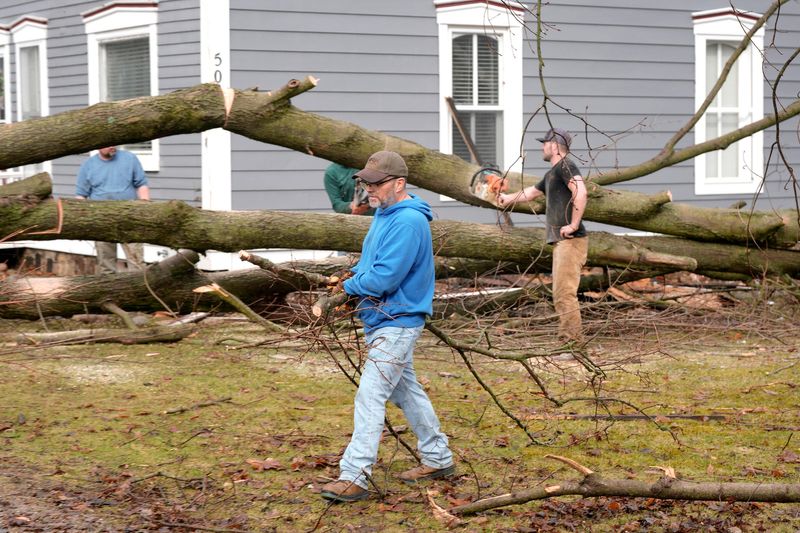
They are in the trees – snapped like toothpicks.

They are in the lake, where houses were swallowed whole by winds up to 160 miles per hour.
They are revealed in the grief of Nanette Swallow, who encountered the bodies of two of her friends after the storm who lived on Prairie Rose Lane in a field. They were standing outside and the tornado struck too quickly. Swallow was returning a dog seeking shelter in her neighborhood. All three people who died here lived on Prairie Rose Lane, where the damage was catastrophic.
Backhoes are clearing mountains of debris. Neighbors comfort each other and discuss property damage. Some watch footage online taken from the other side of the lake, pause it and mark the very moment their property was gut punched by the deadliest storm in these parts in 50 years.
There are plenty of scars but so, too, of something else: radical kindness and decency, which we are told has gone missing in America. Not here, though, where a storm took the lives of three people and blew away generations of memories.
On this quiet spit of land raked over by one of the most powerful storms any local adult has ever seen, victims, strangers, neighbors and friends are setting an example community that we could all use right now in America.
A pontoon boat flies in
Tuttle Park Drive serpentines for about a mile between homes and cabins along Union Lake. Nanette Swallow, who has lived in this tight-knit community for 20 years, is still trying to make sense of what happened on the afternoon of March 6, when the sky turned the color of slate, and a deadly wedge tornado bullied everything in its path.
Someone else’s pontoon boat ended up in her kitchen roof.
“We found pieces of the motor buried in the trees,” she told me, standing on the two previously wooded acres she has called home for 20 years. Swallow is the kind of person who always makes sure others are OK. An emergency response leader told me what a pleasure it has been to get to know Swallow — whom he recently met — even amid such a tragedy.
Swallow occasionally struggled to keep her emotions in check when we talked.
“I think we hold up really well until evening comes. Then, we sit down and think about it, and it just feels overwhelming. So, I just take one day at a time,” she said.
Gov. Gretchen Witmer has asked the Trump administration for emergency assistance for Branch, Cass and St. Joseph counties. Although officials have not provided a final damage estimate, The Detroit News reported that Whitmer asked the president for $1.4 million to help the three counties with temporary housing, repairs and replacement assistance for the uninsured.
Meanwhile, with each passing day clean-up crews are making progress. Roads once impassable are open. Debris is slowly disappearing.
“Two weeks ago, you couldn’t even get down here,” Swallow told me. “Cars were parked at the end of the road.”
Grief here is not abstract. It is personal, immediate and ongoing.
Yet, through the grief, Swallow believes the storm has revealed the best of humanity. “People (are) not thinking about themselves, (they are) just seeing what they can do to help others,” she told me. “They brought warm meals. They dug things out of the swamp. They stayed all day. There are a whole lot of beautiful people out there.”
Counting his blessings
A mile away on Tuttle Road, James Pepper is counting his blessings.
He was standing in his doorway, watching the storm approach — something he said he had grown accustomed to doing after years of warnings that never materialized.
“I used to go to the basement every time,” he told me. “For five or six years. Then I stopped. It didn’t seem like a reason to.”
This time, it was.
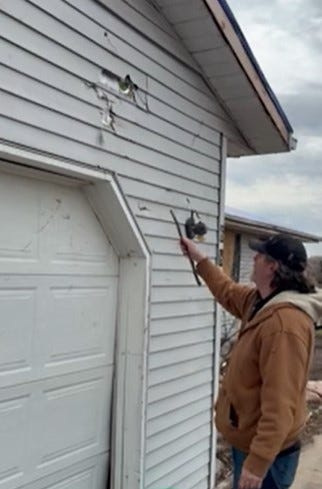
A pine tree in his yard snapped. Pepper ran inside and bolted the door. But the force of the tornado was so strong, it dislodged the whole frame. The damage was done in 15-30 seconds. That was long enough for branches to become spears and embed nearly a foot into the outside walls of Pepper’s home. And for Pepper to lose 16 trees on his property.
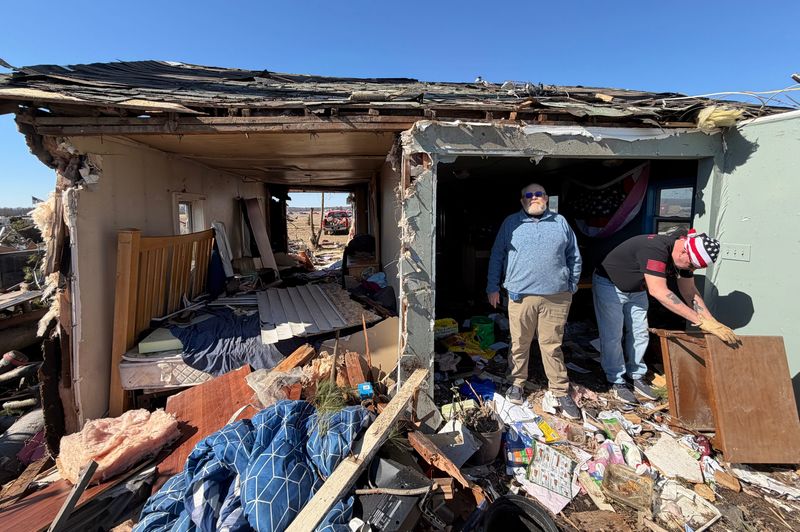
Pepper’s damage was bad, but it could have been worse, he said. His next-door neighbors lost everything. All that was left were two walls framing the bedroom where his neighbors slept, Pepper said. They were not harmed, but one of their dogs went missing – or so they thought. After hours of searching, they found him whimpering on the living room couch under debris, unharmed. Their heavy iron tub, routinely suggested as a refuge during storms, was sucked out of the house.
And then the helpers came. Pepper said 14 volunteers showed up from Samaritan’s Purse, a national faith-based relief organization associated with Billy Graham Ministries. County crews hauled debris, load after load.
“At the end of it, they gave me a leather Bible,” Pepper said. “It has an insignia on it that shows your house was damaged in a storm.”
It is now a cherished possession.
Not as a symbol of what he lost, but of who showed up.
‘No time for grief’
For Branch County EMS manager Tim Miner, the recovery effort resists easy measurement.
“There is no barometer,” he told me. “Every property has a family behind it. And every family is dealing with this at a different pace.”
There is no timeline for grief, no timeline for rebuilding a life.
“Are we where we want to be? No,” Miner said. “But are we in a better spot than we were? Yes.”
Even three weeks after the storm, when I visited, Union Lake holds what the storm deposited. Crews pulled 70 cubic yards of debris from the water in a single day.
“A drop in the bucket,” Miner said.
And yet, in the middle of all that, Miner remembers one man alone in a canoe, in the cold, picking up debris piece by piece.
“No one asked him to. He just wanted to help,” Miner said.
This is what remains after a storm like this.
Not just the damage. But the decision made repeatedly by ordinary people see other people’s pain and offer help.
To prepare hot meals. To clear a yard. To paddle in freezing temperatures in the water and remove what nature left behind.
It is early yet. The wounds on Tuttle Road remain fresh. But if you look closely — past the 100-year-old exposed tree roots and the devastating path of destruction – you will find something as powerful as the storm itself.
People taking care of their own.
We are told every day that we are a divided nation.
That we don’t see one another anymore.
That we can’t agree on anything anymore.
And yet, in a place where homes were thrown into a lake and lives were lost, we are witnessing hope through shared tragedy.
In the quiet after the chainsaws and sirens, what remains is not just debris, but a choice.
What we are seeing in Union City, post-storm, is what Martin Luther King Jr. called the “beloved community,” where we don’t just rebuild structures — we restore one another. Where strangers become neighbors not by proximity, but by purpose.
It should not take an F-3 tornado to jar us into recognizing another’s pain and need for assistance. But sometimes – as noted by Nanette Swallow – shared challenges can bring out the best of humanity. The lesson we can all learn is to strive to be that beloved community all the time, not just when we are down and out.
Byron McCauley is regional columnist for USA Today Co. Email: bmccauley@usatoday.com. Phone: (513) 504-8915.
This article originally appeared on The Holland Sentinel: Amid tragedy of tornado, Union City residents rely on one another | Opinion
Reporting by Byron McCauley, The Holland Sentinel / The Holland Sentinel
USA TODAY Network via Reuters Connect