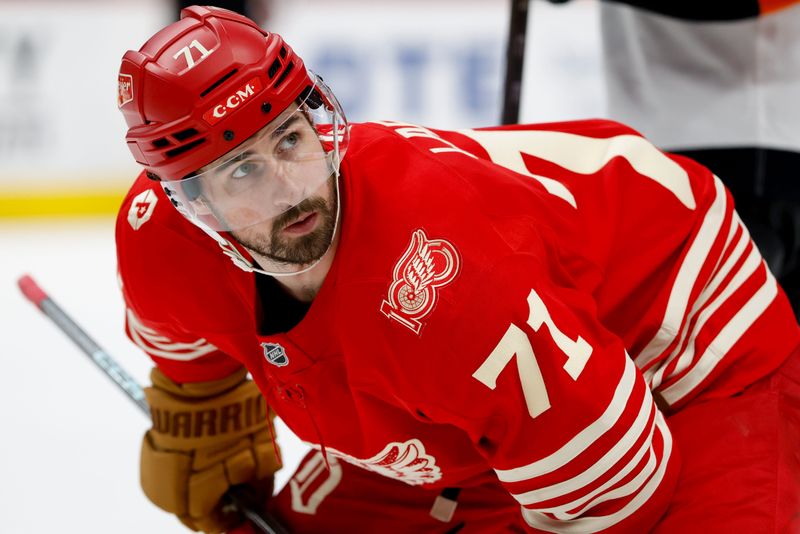
Any deal to comply with Dylan Larkin’s request to be traded comes with a financial deficit for the Detroit Red Wings.
Annual average value is usually the focal point of a player’s salary in the NHL because that’s how the league measures how much he counts against the salary cap. In the case of Larkin, who on Thursday, June 4, asked the Wings to move him, that’s $8.7 million for five more seasons. That in itself is a good value – when the deal began in the 2023-24 season, his contract ate approximately 10.4% of the Wings’ cap room. But with the cap ceiling rising to $104 million in 2026-27, Larkin’s deal will take up only 8.4% of a prospective team’s space. And on the ice, Larkin – who turns 30 on July 30 – is in the prime of his career, a consistent 30-goal scorer.

But look closer, and he’s an even better value for his presumptive future home, wherever that may be.
Larkin holds a no-movement clause, so he is in control of where he lands. So far, he has submitted a short list of destinations, comprised of the Florida Panthers, the Minnesota Wild and the Vegas Golden Knights. All are highly competitive teams – even with the Panthers missing the playoffs last year, which had much to do with significant injuries to key personnel. They look poised to return to contender status next season after winning back-to-back Stanley Cups in 2024 and 2025.
Three teams aren’t much to work with for general manager Steve Yzerman, who faces the prospect of sending away a top-line player just as he enters the lesser-salary years of his deal.
The deal Larkin signed on March 1, 2023, was heavily front-loaded. Worth $69.6 million over eight years, the framework was structured so that the actual salary shapes up as follows:
That means Larkin already has collected $31 million from the Wings three years into the contract. And that wherever he goes, that team lands a very good player – a top-line center, no less, as coveted in hockey as a defenseman who shoots right – for five years with an actual total monetary cost of $38.6 million, an average salary of $7.72 million (though, again, he’ll still count for $8.7 million against the cap).
Yzerman cannot settle for a lesser return in making this trade happen. Ultimately, the NHL is high-priced entertainment – it’s not personal, it’s business (don’t forget to take the cannoli). General managers are not obligated to indulge a player’s request to be traded, so there’s a scenario in which Yzerman goes to Larkin’s camp and says the list needs to be expanded – and perhaps, a scenario in which the matter is unresolved when the 2026-27 season begins.
The bottom line is: The trade must have immediate value for the Wings. They’ll need to replace Larkin with a top-line center, and they already were in need of strengthening their second-line center spot and adding a scoring forward for the top-six mix.
Contact Helene St. James at Hstjames@freepress.com.
Read more on the Detroit Red Wings and sign up for our Red Wings newsletter.
This article originally appeared on Detroit Free Press: How Dylan Larkin’s contract affects Red Wings’ bottom line in a trade
Reporting by Helene St. James, Detroit Free Press / Detroit Free Press
USA TODAY Network via Reuters Connect

By Helene St. James, Detroit Free Press | USA TODAY Network