State lawmakers passed a bill during their last week of the legislative session that would ban the use of surveillance pricing in New York.
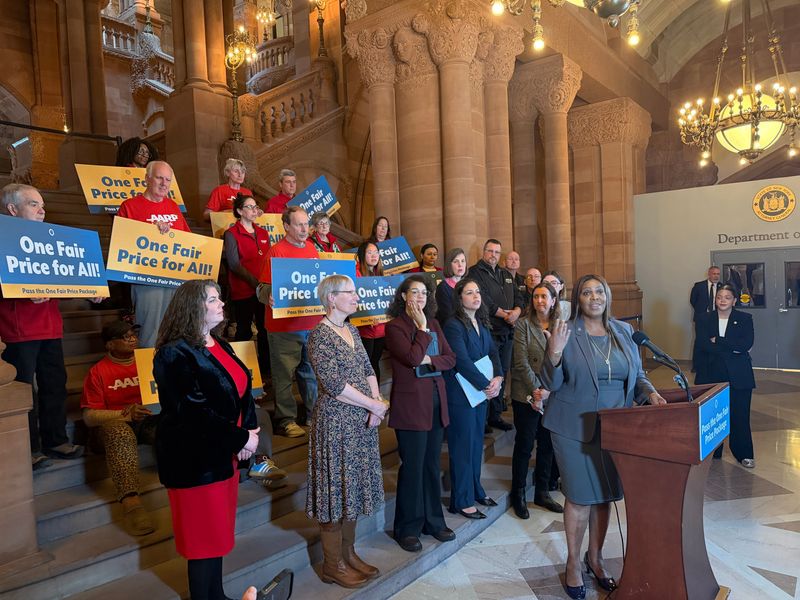
The One Fair Price Act, which prohibits the use of algorithmically set prices and requires the use of automated pricing systems to be disclosed, has now landed on Gov. Kathy Hochul’s desk. Many state leaders, including state Attorney General Letitia James, have pushed for its passage for several months, asserting it would save consumers money. Others, however, have said it would do the opposite.

And while the state Senate also advanced another bill banning electronic shelving labels — the Protecting Consumers and Jobs from Discriminatory Pricing Act — the state Assembly declined to bring it to a vote last week.
The United Food and Commercial Workers International Union applauded the passage of the One Fair Price Act but said the Assembly “stopped short of protecting consumers from predatory pricing schemes” because of their failure to pass the second piece of legislation.
“ESLs have the ability to change prices at a moment’s notice, and banning them is the foolproof way to prevent surveillance pricing for necessities like food,” says UFCW International Vice President Ademola Oyefeso.
“If lawmakers truly want to address the affordability crisis facing New Yorkers, they must pass The Protecting Consumers and Jobs from Discriminatory Pricing Act next session and end price gouging at the grocery store once and for all,” the statement continued.
Here’s what to know.
What is surveillance pricing and why is it harmful?
Surveillance pricing, which consists of companies tailoring prices on goods depending on factors such as your search history, social media habits and where you are in the world, has been used by Instacart at retailers like Target and Costco, according to a recent Consumer Reports and Groundwork Collaborative investigation.
The online grocery marketplace explained in December that they, along with their partners, don’t allow the use of “personal, demographic, or user-level behavioral information about individuals to set online item prices on Instacart.”
Walmart also recently announced the rollout of electronic shelf labels in thousands of its stores and is planning to expand the system chain-wide within the next year, saying it would help employees “save significant time by eliminating the manual task of changing prices.”
Red flags are being raised about the practice, however, because of its potential to lead to biased pricing, if left unchecked. Since the prices determined by surveillance pricing are a result of someone’s personal data and possibly result in companies offering different prices to different people for the same product, state legislators assert it could cause discriminatory pricing.
They also say New Yorkers’ privacy rights are being violated by the practice and the use of surveillance pricing could possibly eliminate jobs statewide.
How would the One Fair Price Act protect New Yorkers?
The One Fair Price Act keeps companies from using a consumer’s personal data to set prices on items from groceries to clothing. One of the bill’s sponsor’s, Assemblymember Emerita Torres, a Bronx Democrat, called surveillance pricing “exploitation, plain and simple,” and says the legislation will also promote fair competition in the marketplace.
“Surveillance pricing represents a fundamental shift in how prices are set,” Torres said. “Behind our screens, corporations quietly collect treasure troves of our personal data.”
“Companies will call this personalized pricing, which can suggest that is a type of value in this type of pricing for the consumer,” Torres added. “But the reality is that we, as consumers, as New Yorkers, have no idea what a true price is anymore because I can get a different price compared to my neighbor for the very same product or service.”
Torres later added that New Yorkers shouldn’t have to pick between “affording our groceries and protecting our privacy.”
If a company violates the One Fair Price Act, they could see a $10,000 fine per violation and each ensuing violation could result in up to $25,000 per violation.
“New Yorkers know it is wrong for companies to use their personal information just to charge them more,” Attorney General James said of the bill’s passage by the state Legislature. “When this bill becomes law, shoppers will be able to trust that the price they are paying is a fair price, not one dictated by their web browsing history, income, race or zip code.”
What the opposition says about banning surveillance pricing in New York
Several tech and business groups have opposed its passage, expressing concerns that the legislation would also prevent New York consumers from receiving much-needed discounts.
Tech industry trade group Chamber of Progress says they’re on board with stopping companies from using people’s personal data to charge shoppers more, but says this bill prevents companies from using it to charge people less.
“By treating a lower price as a harm to be policed, it would strip away the loyalty deals, digital coupons, and personalized savings that families count on to manage rising costs, all while making New York the test case for an experiment that is both untested and unpopular,” the organization’s policy manager Drew Ambrogi said in a statement.
A handful of lawmakers also took issue with the legislation. Sen. Patricia Canzoneri-Fitzpatrick, a Long Island Republican, and Assemblymember Phil Palmesano, R-Corning, both said they believe it prevents or limits discounts across the state.
“To me, this is more about more misplaced priorities at a time when our families are struggling in the midst of an affordability crisis,” Palmesano said. “Now is not the time to institute an outright prohibition on certain discounts, coupons and promotions.”
“This would exacerbate the ongoing challenges facing our New York families rather than providing meaningful solutions,” he added.
On the Senate floor on Thursday, June 4, one of the bill’s sponsor’s, Sen. Rachel May, a Central New York Democrat, said while it does ban the use of one’s personal data for both lowering and raising individualized prices, there are exceptions to the ban.
Companies can use a customer’s previous purchase history to set prices as well as whether they have signed up for a loyalty program or qualify for a group discount such as veteran- or senior-specific discounts.
“The reason there is so much lobbying against this bill is that it makes a lot of money for the companies if they can set the highest possible price, ” May said. “They may call it a discount, but really what they’re trying to do is get the highest possible price out of each person based on the data that they have.”
Emily Barnes covers state government for the USA TODAY Network-New York with a focus on how policy and laws impact New Yorkers’ taxes, communities and jobs. Follow her on Instagram or X @byemilybarnes. Get in touch at ebarnes@usatodayco.com.
This article originally appeared on Rockland/Westchester Journal News: NY passes surveillance pricing ban. How it could cost, save you money
Reporting by Emily Barnes, New York State Team / Rockland/Westchester Journal News
USA TODAY Network via Reuters Connect
By Emily Barnes, New York State Team | USA TODAY Network