Andy Pages was not subtle about his hand and arm movements from his spot near second base in the fourth inning, seemingly signaling to the hitter at the plate what pitch was coming.
And there was nothing the Milwaukee Brewers could do about it.

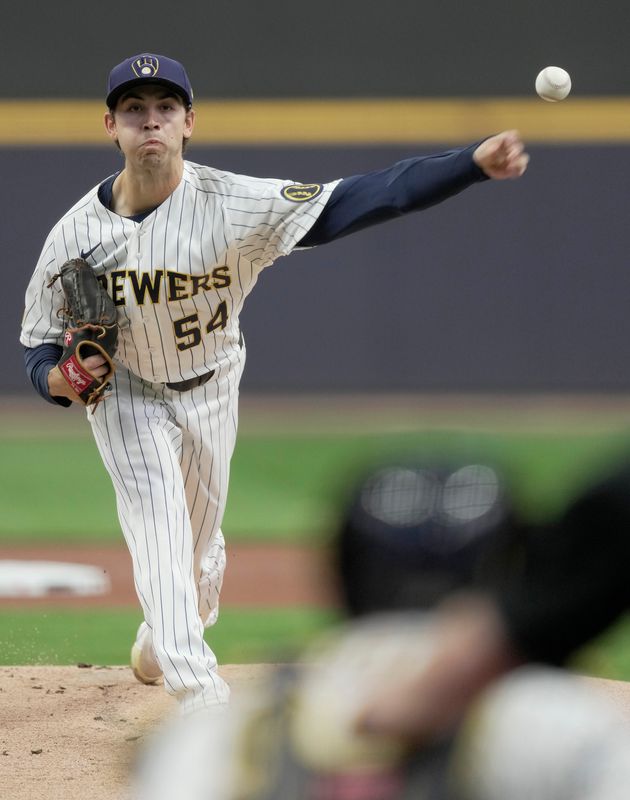
Pages appeared to know what was coming via some sort of tell from either pitcher Robert Gasser or catcher Gary Sánchez during the game-swinging at-bat in the Los Angeles Dodgers’ 11-3 romping May 23 at American Family Field. That inning, the Dodgers scored four runs to erase a 3-0 deficit and never looked back.
The big swing came from the bat of Teoscar Hernández, a three-run blast off the foul pole on a sweeper a few inches off the inside corner. The Dodgers slugging left fielder turned on it and kept his hands just enough inside the ball to prevent it from hooking foul, the type of swing a hitter puts on a ball he knows is coming.
“Teams are really good at it,” Brewers manager Pat Murphy said. “Everybody studies it. We study it. We don’t come in here and tell you when we had pitches at second base, but it was pretty evident that maybe they did at second base.”
Box score | Standings | Schedule
The Brewers, to be clear, had no issue with Pages relaying signals. They do it, too, including having a tip on the Dodgers themselves.
“There’s a huge emphasis on that,” Murphy said. “Pitchers have to be able to not give away anything. It’s gotten to a science. Every team does it. We do it. Some teams do it less subtle than others.”
Gasser noticed Pages giving signals with his hands, sometimes tapping his helmet while on other pitches lifting his right or left hand, but didn’t say either way if he knew he was tipping.
“I did look back once and saw him moving his hands,” Gasser said. “When I came in, I saw some of the hand signals. I haven’t looked in-depth at it. I saw some of the photos. It seemed like my hand was getting covered but I’ll have to take a look at it.”
Gasser has dealt with tipping issues in the past.
“It’s definitely something that’s come up before,” he said. “It thought I had a good grip on it and was covering it up. Maybe they had something. Maybe not.”
This is the modern game, Murphy said after his team’s loss. Clubs have entire departments of people poring over video to catch any slight tip, from wrist position to how the pitcher closes his glove to a catcher’s positioning.
“When you go into your glove, for instance, you go into your glove and you’re used to gripping the ball a certain way, certain timing, maybe flash a little bit or maybe have more of your wrists showing,” Murphy said. “Maybe it’s from your catcher. Maybe your catcher is moving too soon, maybe your glove angle is a bit different on off-speed compared to fastball. We had pitches tonight on the Dodgers, little things they did. There’s a relay system in how you get that.”
This isn’t the first time tipping has come up for the Brewers. Brandon Woodruff has experimented with different set positions with runners on second, while Trevor Megill worked hard at it after his early-season struggles. The Chicago Cubs even had pitches on Aaron Ashby earlier this week, though it burned them when they relayed the wrong grip and it resulted in some pivotal strikeouts.
Either way, it’s no excuse, Gasser said, for the pitch he made to Hernández.
“We were trying to go back door there,” he said. “Just got too far our in front of it. It was off the plate but it was thigh-high and that’s not a good spot to be.”
This article originally appeared on Milwaukee Journal Sentinel: Brewers think Dodgers knew what pitches were coming against Robert Gasser
Reporting by Curt Hogg, Milwaukee Journal Sentinel / Milwaukee Journal Sentinel
USA TODAY Network via Reuters Connect