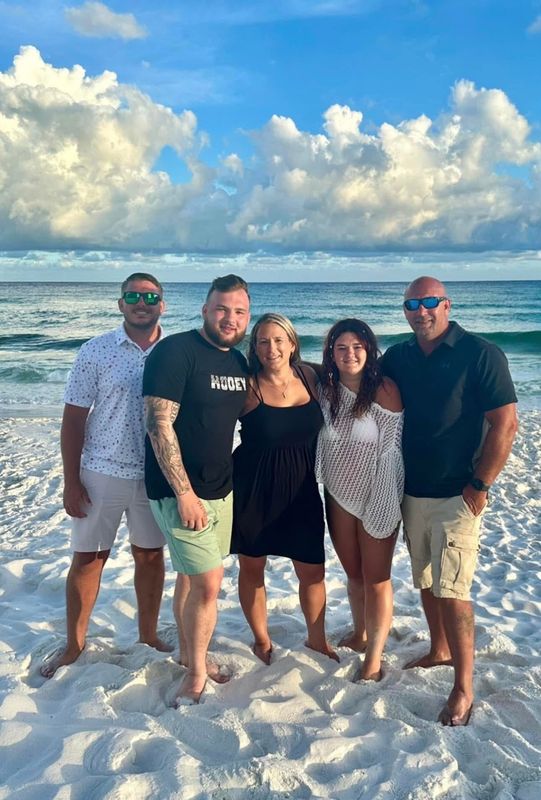
Rachel Tussey’s tummy tuck surgery was successful, according to her doctor. But something went wrong as she was recovering at an Evendale surgery center, leaving her at a hospice facility with irreversible brain damage before she died March 17, her family said.

Relatives said Tussey, who was sharing her makeover journey with followers on social media, was at JourneyLite Surgery Center, an ambulatory surgery center.
A 2018 report on such centers found 260 patients died at these centers in the prior five years. An industry group says the centers have led to lower costs and excellent results for patients.
Tussey’s case is still unfolding. Her family has hired a lawyer and little is known about what happened at the center. But her sudden collapse has her family and followers seeking answers about staffing, oversight and emergency resources at such facilities as they take on increasingly complex procedures.
Who is Rachel Tussey?
Tussey, a 47-year-old mother of three, was documenting her life on TikTok as “midlifeunmuted” leading up to her surgery. She shared positive thoughts aimed at other women in their 40s on her account with over 70,000 followers.
Her husband, Jeremy, said she was speaking to him after the Feb. 25 surgery but became unresponsive after she was given pain medication. She was rushed to Bethesda North Hospital, he said.
In a TikTok video, her husband said the doctors at the hospital told him his wife was brain dead and he was faced with the decision of taking her off life support. She spent nearly two weeks in a hospice facility before she died.
The doctor who performed the surgery, Dr. Shahryar Tork, issued a statement March 12 saying he is “heartbroken” by what happened. He said she was “recovering as expected” before he turned over her care to the center’s staff. Tork said he is discontinuing procedures at the center.
He did not speculate about what might have happened saying “I am struggling to understand how this could have occurred.”
What are surgery centers?
Ambulatory surgery centers are outpatient facilities that provide same-day surgical care. Many of the hospitals in Cincinnati have outpatient surgery facilities or clinics, ambulatory surgery centers differ from those at hospitals because they often focus on certain specialties and are commonly private, for-profit businesses.
In this case, JourneyLite’s website advertises bariatric services like gastric bypass surgery. Tummy tucks or abdominoplasty are considered plastic surgery.
The centers are experiencing “exponential growth,” according to a 2023 paper. Surgeries performed at centers are about 60% of the cost of surgeries performed at hospital-based outpatient departments, the paper states.
There are about 6,500 Medicare-certified centers in the U.S., according to Kara Newbury, chief advocacy officer at the Ambulatory Surgery Center Association, a nonprofit group supporting the industry.
“Patients like the personalized care, reduced wait times and lower costs that ASCs offer,” Newbury said in a statement to The Enquirer. “Physicians like the ability to schedule procedures more conveniently for patients, assemble teams of specially trained and highly skilled staff, and ensure that the equipment and supplies being used are best-suited to their techniques.”
Newbury said surgery centers scored an overall patient rating of 95.4% compared to 94% for hospitals in a recent survey by the Centers for Medicare and Medicaid Services.
How are emergencies handled?
Jennifer Lawrence is a lawyer with Covington firm Lawrence Beirne & Lewis and has previously represented families who believe they have suffered harm at surgery centers including JourneyLite. She’s practiced medical malpractice law in Cincinnati and Northern Kentucky for 30 years.
Ambulatory surgical facilities, typically, are not governed by the same regulations as hospitals in the U.S., Lawrence said. She said that the federal Joint Commission conducts regular onsite inspections of the vast majority hospitals to uphold strict standards of care, but surgery center can exist without any Joint Commission oversight.
“When medical emergencies arise, ambulatory surgical facilities often do not have the capability to provide emergent life-saving care,” Lawrence said. “This occurs in either not having medical and nursing staff with sufficient knowledge to respond to the medical emergency or in not having the medical equipment available to perform a life-saving procedure.”
Newbury said that in the rare case of an emergency, centers are required to have procedures in place to get patients to hospitals.
“Ambulatory surgical facilities are equipped for outpatient procedures or surgeries, but not medical emergencies,” Lawrence said.
Who oversees surgery centers?
Patients may shop around and vet their doctors and surgeons for elective surgeries but they may not be aware of the credentials of the staff at the surgery center where the procedure will take place.
“The difficulty is locating the information when it is not readily accessible to the general public,” Lawrence said.
In some states, surgery centers are not licensed by the state, but in Ohio, there is a license requirement and regulations spelled out in the Ohio Laws and Administrative Rules. For example, patients cannot stay at a center for more than 24 hours. The administrative rules do not dictate what specific surgeries and procedures can and cannot be performed at a surgery center.
There are rules that govern equipment. For example, facilities doing procedures that require general anesthesia should have the tools needed to keep a person breathing including “oxygen delivery capability under positive pressure, suction equipment and suitable resuscitative drugs.”
Those who go under general anesthesia should be “constantly attended by the responsible anesthesiologist, CRNA, anesthesia qualified dentist, physician or podiatrist acting within their scope of practice, or an RN until conscious and in the ambulatory condition normal for him or her,” the rules state.
Newbury said surgery centers comply with a wide range of laws, rules and regulations, and that most centers are Medicare certified. Centers can earn additional accreditations through independent health care rating agencies.
“When it comes to the emphasis placed on patient safety, there is no difference between a hospital and a surgery center,” Newbury told The Enquirer in a statement. “Just like in hospital operating rooms, the surgeons, nurses and medical professionals in ASCs follow a very specific set of protocols and procedures that consistently lead to excellent results for surgical patients.”
The Ohio Department of Health is tasked with the oversight of surgery centers. Lawrence said the department inspects facilities during the license process and any time there is a complaint or allegation against a facility.
Notable cases
A 2018 investigation by USA TODAY and Kaiser Health found that more than 260 patients died in five years at U.S. surgery centers and that centers are taking on “increasingly risky surgeries.”
“Recent years have seen a rise in ‘nuclear verdicts’ – jury awards exceeding $10 million – in lawsuits against ASCs,” according to a 2024 article from the insurance advisory firm RCM&D.
In Oregon, a jury awarded $25 million to the family of a man who died during a routine colonoscopy.
A Florida law firm reported that it won a $1.1 million settlement for a man who suffered a stroke during a shoulder procedure at a surgery center. That law firm said that with more surgery centers, comes more mistakes at places where “standards are reduced, oversight is poor, and consequences are grave.”
According to federal court documents filed in 2013, the fugitive Dr. Abubakar Durrani partially owned the JourneyLite Surgery Center at that time. That is the facility where Tussey’s surgery was performed.
More than 500 lawsuits were filed against Durrani by patients who suffered injuries from medically unnecessary surgeries he performed, according to court records. He fled the U.S. to Pakistan to avoid prosecution. State records do not make it clear how the business ownership changed after Durrani fled.
What is JourneyLite?
JourneyLite has five locations in the region and its website advertises lap band and gastric bypass surgeries but not abdominoplasty.
The company is certified by the Centers for Medicare and Medicaid and the Accreditation Association for Ambulatory Health Care. The center is also recognized by Anthem, United Health Optum and Aetna, according to its website.
Some surgery centers are accredited by the Joint Commission, a U.S. nonprofit that accredits nearly all hospitals. JourneyLite is not listed on the commission’s website among its accredited facilities
It is unclear who currently owns JourneyLite and its associated entities. Dr. Trace Curry is listed as the medical director. There is no indication he was involved with Tussey’s surgery.
The Ohio Department of Health has conducted surveys of JourneyLite, which includes inspecting the facilities and any allegations made against the center.
The most recent state involvement in JourneyLite was a “substantial allegation survey” in November 2025. The survey found that the business was in compliance. Allegations made against a surgery center in Ohio are not public record. If the business was found to not be in compliance after an investigation, more details would be available.
Since 2018, there were two other surveys done of the surgery center. One in May 2019 found issues related to fire safety at the Reading Road facility. A second survey for June 2019 states all the problems found in May had been corrected.
JourneyLite has not responded to multiple calls and messages seeking comment.
This article originally appeared on Cincinnati Enquirer: A routine tummy tuck, a sudden emergency. What is a surgery center?
Reporting by Cameron Knight, Cincinnati Enquirer / Cincinnati Enquirer
USA TODAY Network via Reuters Connect