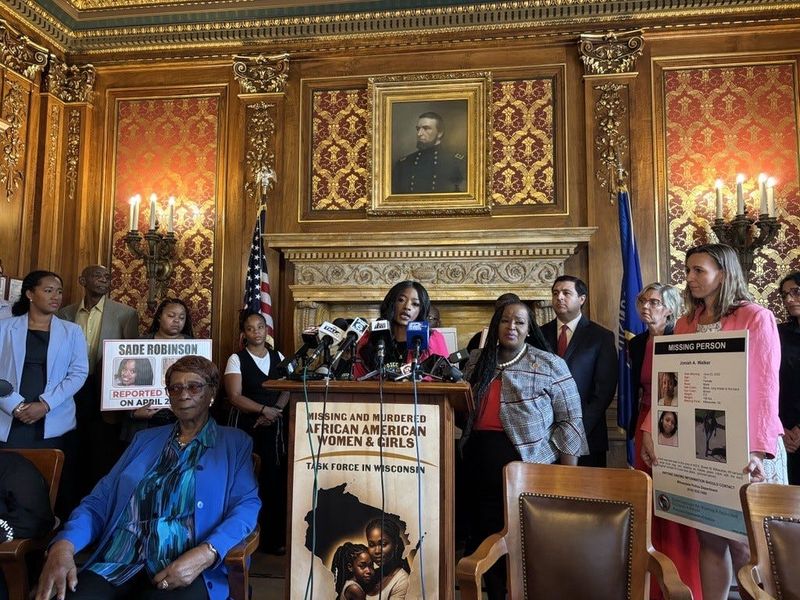
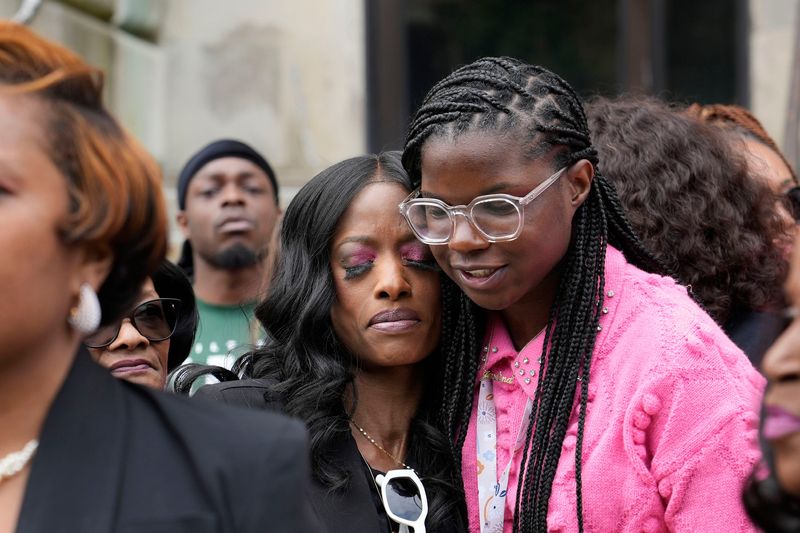
MADISON – Less than two months after Maxwell Anderson was found guilty of killing and dismembering Sade Robinson, her mother, Sheena Scarborough, went to the state Capitol with a plea.
Alongside other advocates, she pressed lawmakers to establish a task force to examine why so many Black women and girls go missing or are murdered in Wisconsin — a proposal that goes back four years but has never become law.

Scarborough said her daughter’s disappearance was the “worst nightmare anyone could imagine,” but having a task force could help families who may have a similar experience.
“It’s just unimaginable of what you have to go through. There’s no ifs ands or buts, the task force is definitely needed,” she said. “This is a must.”
State Rep. Shelia Stubbs, a Democrat from Madison, reintroduced legislation to create the task force for a third time at the July 25 news conference.
The task force would submit a report with recommendations to the state Legislature after examining the systemic causes of violence against African American women and girls, ways to help victims’ families heal, methods to track data to understand the scope of the issue and more.
Black women in Wisconsin were 20 times more likely to be murdered than white women in 2019-20, according to research from Columbia University published last year.
Wisconsin had the greatest racial disparity in homicide rates in the study, which spanned from 1999 to 2020 and analyzed 30 states.
Also at the press conference was Tanesha Howard, the mother of Joniah Walker, a 15-year-old Milwaukee girl who went missing in June 2022 and has not been found.
“Our kids, they’re unsafe. People are snatching our children away,” Howard said. “(This legislation) would help. I hope it passes.”
Families of missing and murdered Black women and girls are already interested in writing policy and strengthening existing laws, Stubbs said previously, and the task force would be a place for that work.
Bill could have different political fate this year
The bill’s fate this session could be influenced by a surprising factor — new legislative maps that reduced Republicans’ advantage in the state Legislature in 2024.
Last year, the Assembly passed the task force bill after an Assembly committee unanimously approved it. But the Senate never took it up on the floor — the final step before it would go to Democratic Gov. Tony Evers and become law.
The bill sat in the Senate’s committee on government operations, chaired by former Sen. Duey Stroebel, for four months before it was reassigned to a different committee.
Stroebel previously said he would not hold a public hearing on the bill, citing his belief that every missing or murdered person deserves equal justice, and justice should not be prioritized based on a victim’s race or gender.
The path may be different this session — Stroebel is no longer in the state Legislature, after narrowly losing reelection to Democratic Sen. Jodi Habush Sinykin in the most expensive legislative race in state history. Stroebel was recently named the Midwest region administrator for the U.S. Department of Housing and Urban Development.
But the new maps could affect the bill’s chances in another direction. Former state Rep. Michael Schraa, a lead Republican working on the bill, also lost his seat after being drawn into a district with another lawmaker.
While Evers suggested creating the task force in his budget proposal, Republicans removed it during the budget-writing process. It didn’t end up in the final document.
Previous versions of the bill would have placed the task force under Attorney General Josh Kaul, a Democrat, and the state Department of Justice that he leads.
Kaul has said previously that the DOJ needs adequate resources, funding and staff to carry it out, while Stubbs argues the work is urgent and “the money will come along.” During the media conference, he said the state needs to invest in solving this issue.
“We frankly, would like more investment than even this bill can provide,” he said. “It takes effort, and a small investment, as is being requested for the Legislature here, and is amply warranted by the need to invest here so we can improve safety.”
The current iteration of the proposed legislation, which has not yet been released, will include funding for one full-time position. That person would help the 17-member task force with coordinating meetings, research and outreach to families.
“I think any life is worth one full-time position,” Stubbs said. “It’s a start. It’s one person.”
This story was updated to correct a misspelled name.
This article originally appeared on Milwaukee Journal Sentinel: Weeks after Maxwell Anderson trial, Sade Robinson’s mother pushes again for legislation
Reporting by Hope Karnopp and Laura Schulte, Milwaukee Journal Sentinel / Milwaukee Journal Sentinel
USA TODAY Network via Reuters Connect