Residents of Bakersfield, Sacramento, Stockton, and more may find that living in these California cities especially challenging regarding seasonal allergies.
The Asthma and Allergy Foundation of America released its 2025 Allergy Capitals report right in time for spring, ranking the most populous cities in the lower 48 based on tree, grass, and weed pollen counts, allergy medication usage, and the number of allergy specialists.

While the top 20 cities that are the worst for people with seasonal pollen allergies are largely spread out in the southern and eastern reaches of the United States, the rankings of some California cities weren’t too favorable.
The California cities that had a worse-than-average score total, based on those factors above, are:
The report found that California faced increased grass and weed pollen counts last year compared to 2023. Sacramento, Bakersfield, Stockton, San Jose, Fresno, Oxnard, Los Angeles, and San Francisco were all cities that were ranked significantly higher on this year’s Allergy Capitals report than last year due to much higher pollen. Wet weather likely contributed to the increased growth of grass and weeds, the report said.
Allergy forecast: Climate change is making allergy seasons worse
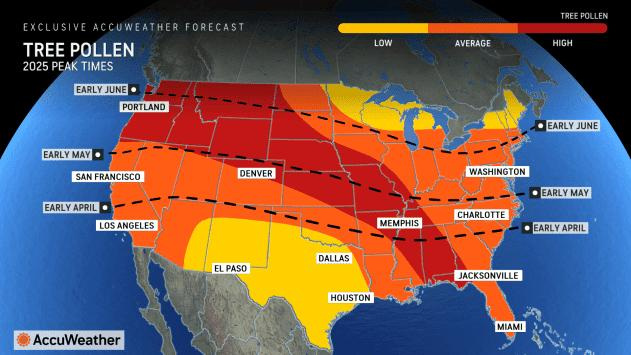
Spring allergies can begin in February and last through the summer in certain parts of the U.S., according to the American College of Allergy, Asthma & Immunology. Tree pollen is the first pollen to appear each year in the U.S., and while grass pollen can be found year-round in warmer parts of the country, it can overlap with tree or weed pollen seasons, according to the Allergy Capitals report.
The pollen season starts earlier in California because the state has a milder winter, according to IQAir. Most of California is forecasted to see average levels of tree pollen, grass pollen and weed pollen during peak times throughout the spring and summer, according to AccuWeather.
Unfortunately for seasonal allergy sufferers, climate change leads “to longer and more intense allergy seasons,” as trees release pollen earlier in the year and weeds persist later into the year, the report said.
Warmer temperatures and less snow cause plants to grow sooner, producing more highly allergenic pollen in response to rising carbon dioxide concentrations in the atmosphere, according to the report.
What other California cities made the 2025 Allergy Capitals report?
San Diego was one populous California city with a better-than-average score on the 2025 Allergy Capitals report. Ranked at No. 97, the Southern California city had better-than-average scores across all factors, such as pollen count and medicine usage.
Cities with average total scores were:
The report acknowledges some limitations in the data, such as that the medication data is related to over-the-counter medicine for pollen allergies, not accounting for people who have prescription medicines, or that the medicine could be used for other purposes like colds. Also, pollen data doesn’t account for the strength of the allergic response to the pollen.
How long do seasonal allergies last?
Symptoms can persist for a few weeks to several months. How long you’ll be dealing with your seasonal allergies depends on your level of sensitivity and which pollen or mold is causing you trouble.
Arizona Republic reporter Meredith G. White contributed to this report.
Paris Barraza is a trending reporter covering California news at The Desert Sun. Reach her at pbarraza@gannett.com.
This article originally appeared on Palm Springs Desert Sun: Suffering from seasonal allergies? Some California cities may be worse for you than others
Reporting by Paris Barraza, Palm Springs Desert Sun / Palm Springs Desert Sun
USA TODAY Network via Reuters Connect